Thursday, May 28, 2015
Greens Aerification
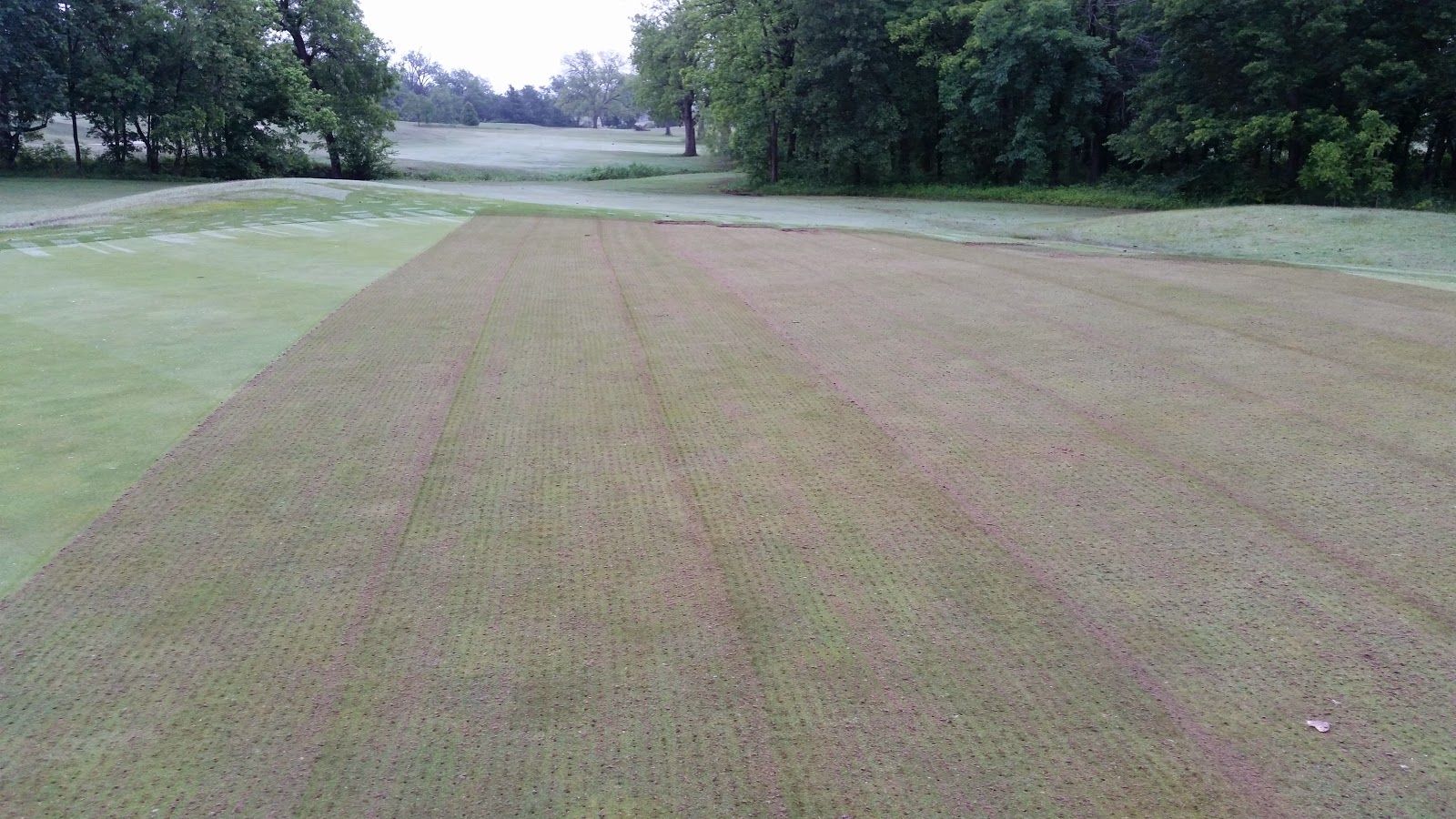
On Tuesday of this week we went out and aerified our greens with 1/4 inch side eject tines. With all of the rain that we have been getting this month, it is very important to open our bentgrass greens up as often as we can. This allows our greens to "breathe" and get important air down into our root system. Over the summer, we try to do this process once a month to help with the heat of the summer and it also helps with any excessive compaction that we might get with all of our equipment being on our greens (greens roller, mowers, topdressers, sprayers, etc). Tuesday we did pull a small 1/4 inch core when usually we just use a solid tine. With the extreme rainfall and cooler temps, we went ahead and pulled some material out that will also help with any algae spots that we are starting to see on our greens from the rain. We followed up this aerification on Wednesday with a fungicide application that focused on Algae and patch diseases. Over the next 4 months, we will be spraying some type of fungicide every 14-21 days to help prevent any diseases that we might get due to the heat and humidity. On the bright side, it looks like the rain might be coming to an end on Saturday. We are hoping for a dry week next week so we can get some things mowed out for The Gusher coming up next weekend.
Thursday, May 7, 2015
Greens Edging and Topdressing
Before this last rain came in, we were busy doing some things around the course. On Monday we worked on getting our greens edged. This process helps with keeping the edge of our greens between the Bentgrass and Bermuda crisp and helps keep any Bermuda grass runners from contaminating our greens. This is something that we try to do at least every 2 weeks to maintain that edge the way we want it. Our process is usually marking the edge with a dotted line, edging with our walk behind edger and blowing off any debris that the edging leaves.
On Tuesday, we topdressed our greens with a light layer of sand and also fertilized our collars in preparation for the coming rain. Topdressing greens is a very important part of what we do here. This process helps us keep a firm and smooth surface. We try to do this every 10 to 14 days. All depending on the weather and how much growth we are getting at the time. We will topdress the green, broom, and water. We have two 5 foot walking brooms that our crew use during this process. Brooming is important because it helps get the sand down into the canopy where it belongs so our mowers don't pick up more than they have too. Using these walk brooms keeps us from having to get a cart on our greens which keeps the stress down and eliminates 99% of any bruising that might occur. Attached are some pictures that we took of these practices.
Tuesday, April 28, 2015
Rain, Rain and more Rain
This spring has been a wet one to say the least. It seems like as soon as we get dry enough to do some mowing and cleaning up it rains again. We are trying our best to keep things maintained but we would also ask for your patience as we have to wait for things to dry before we can get our heavy mowers out there to get things done. With another 1.5 inches last night, our golf course is once again saturated. Please continue to follow our cart path rules and directional markers. Anytime you can stay on the cart path during this extreme wet period please do. We don't need anymore tire marks/ruts in our wet areas. If you haven't been out in a while, I have attached a picture of our markers that are on most of our approaches. Please, when you approach these markers return to the cart path. 
Sunday, March 8, 2015
Burning Brush
This past week you might have thought that it was a slow week for us here at maintenance, when actually it was a very productive one. With snow being on the ground for 4 out of the 5 days and light winds, we took advantage of the opportunity and burned our brush piles out at #17. These limbs and debris are from our routine trimming we do around the course throughout the year. During this past week, we were able to get everything burned that we needed to. The snow allowed us to have a bigger fire than we normally would have which in return, lets us push bigger piles in with our tractor instead of just hand feeding it. We ended up getting a years worth of trimming burned up in just a few days.
Also, please remember that we will be aerifying greens 2 times this spring. We will be deep tining on March 17th and then turning around and doing our traditional aerification on Monday, March 23rd. As long as the weather continues to stay warm, our holes should be healed in 7-10 days.
Friday, February 6, 2015
Pre-emergent Application
As spring is approaching, we decided that this week would be a good week to start our spring pre-emergent application. Our area of emphasis for this week were clubhouse grounds, collars and some of our creek banks. One area on the course that we wanted to clean up this year were our creek banks around our maintained turf. Areas like #3 approach, #13 approach, #14 approach, etc, are areas that last year might have gotten a little out of hand when it comes to weeds. We are hoping that with a spraying program that these areas are a little bit more "maintained" this year. These areas are not something that we plan on weed eating every week, but hopefully with these areas weed free, you will find it more enjoyable when you play your round. We also sprayed our collars this week. We finished those on Wednesday before the 40mph winds and cold front hit. We sprayed 2 laps around each green which will help with any poa annua that has popped up in the last month. You should see some activity from these applications over the next couple of weeks. In all of our spray tanks we have a pre-emergent herbicide, roundup, and a 2,4-d of some kind to take care of any weeds that are in these areas. Next week we plan on spraying Tees, fairways and surrounds. Below are some pictures of the week to hopefully give you some insight on how we made these applications.


Sunday, January 25, 2015
Ball Mark Repair
Over the last few months, I have been noticing an increase in ball marks that aren't repaired. Although play has slowed down during these winter months, it is still very important to repair your ball marks on our putting greens. During this time of year, our bentgrass putting surfaces will freeze during the cold winter nights and thaw out during the heat of the day. This process tends to make our greens softer than they usually are during the peak growing season. With the softer greens, it causes the mark from your golf ball to be much deeper, which makes it even more important to repair. Ball marks that aren't repaired can take 2 to 3 weeks to properly heal. Repairing these ball marks will allow you and your fellow members to enjoy the smoothest playing surface possible.
If some of you are unsure how to properly repair a ball mark, I have attached a video from the USGA for some helpful tips. As always, if there are any questions, please feel free to contact me.
https://www.usga.org/turf/articles/video/repairingballmarks.html
If some of you are unsure how to properly repair a ball mark, I have attached a video from the USGA for some helpful tips. As always, if there are any questions, please feel free to contact me.
https://www.usga.org/turf/articles/video/repairingballmarks.html
Tuesday, August 26, 2014
Greens Spiking and Wetting Agent
Yesterday we took advantage of another closed Monday and spiked greens. Spiking greens is a less aggressive way to aerify. The spikes go about 1 to 1.5 inches into the ground. Although we aren't getting 4 to 5 inches down like we would with our Procore, we still get great benefits out of this. Anytime you can open up the canopy and relieve some compaction and add oxygen to the root zone is a good thing. Behind the spiking, we used our greens roller to roll everything back smooth. We followed our roller by making a wetting agent application. Wetting agents help keep consistent moisture across the entire green and helps drive water through the soil so our greens don't stay to wet. Below are some pictures and a few videos of our process yesterday.
Thursday, May 8, 2014
Seasonal Color
With the golf course being so busy this past Monday and Tuesday with tournaments, we took some time to work on our flower beds around the clubhouse. We cleaned out any old mulch that was still around from the previous year and also added a pre-emergent to hopefully help with limiting our weeds that we have to pull throughout the year. We chose 3 different types of flowers this spring, which were petunias, lantana and impatiens. The petunias and lantana will do great in our full sun beds that we have and the impatiens will be put where it is mostly shade. We followed these plantings with a new layer of mulch that always makes things look great.
Friday, April 18, 2014
Mulched Areas
Over the last few weeks, our maintenance crew has been trying something new around the course. We have always had these areas on the course that are somewhat out of play but also will get the occasional golf ball landing in them. These areas are hard to grow grass in because of either no sunlight or no sprinkler heads in the area for the irrigation that it would need. We decided to make these areas into mulched beds. We put up some edging around the area that we wanted to mulch that will hopefully keep the mulch in place throughout the year and also keep people from driving through these ares. The mulch looks nice and you can also still play your golf ball off of it if you happen to hit it in there. We have already had a few comments on what we have done so far and everything has been positive. Here are a couple of pictures of the before and after.
Please help us take care of these areas by keeping carts away from these beds. We have also started some sodding projects around the course. These areas have stakes and ropes around them so please helps us keep this sod alive by staying out of the roped areas as well.
Tuesday, April 8, 2014
Collar Aerification
We are back! I haven't been doing a very good job keeping up with blog post over the past year. Seems like once we get into our busy season it was forgotten about. I have had several people ask about what happened to our blog and I am proud to say that we are going to start being more consistent with our blogging again.
Spring is well under way and our bermudagrass is finally starting to show signs of life. Over the last two weeks the golf course has really started to green up. As always, our shorter cut grass (collars, tees and fairways) are always to first to get going. To help with our green up, we decided to start our aerification process this week. We started today on our collars and will begin our tees and fairways tomorrow. Our plan was to start everything on Monday but the rain on Sunday forced us to wait till today. This process helps us relieve any compaction and help get some needed air down through the canopy and down to the roots. Hopefully with it being in the mid-80's on Thursday and some more chances of rain this coming weekend, we can encourage our bermudagrass to start greening up and growing.
We will be finished with everything by Friday afternoon and have everything cleaned up by the weekend. I will post some pictures of our Tee and Fairway process as soon as we get started.

Wednesday, February 20, 2013
Brown Patch and Stump Removal

Over that past few weeks we have noticed some cool season brown patch on our putting greens. This disease is common when you have continuously wet leaf blades of at least 10 hours or so. Cloudy weather, humid nights and dew increase disease severity. Brown patch is also particularly bad on areas the have been fertilized with excessive nitrogen. This winter we have been fertilizing more than usual to try and keep the greens growing throughout the winter. We sprayed a fungicide called Daconil Weather Stik at 4.9oz/m and by the end of the week we had control on the disease. Attached are some pictures of brown patch that was on our putting green and our assistant superintendent Craig Robinson spraying fungicide last week. We also had Terry Sisco with Sisco Turf Services come in and take care of some stumps we had on the course. Terry ground down 27 stumps in about 8 hours and really cleaned up the course. Attached are some pictures and also a video of Terry in action on #11. Terry will be back on the property next month to deep tine our greens again during aerification. Wednesday, January 2, 2013
Cart Traffic
It's a new year and I thought I would start it off by talking about our cart traffic on the golf course. You have probably noticed that we have put up some ropes and stakes again around the course. We felt like we had to do something to stop the traffic around greens and tees or we would regret it come spring time. Please help the maintenance department by staying on the cart path around all tees and greens. We are cart path only on all par 3's. Below is an article that I would like for you to take the time and read. Thank you for your support in this matter.
The article is written by Bud White, Director of the USGA's Green Section's Mid-Continent Region is titled:
Buddy Up: Reduce single rider golf cart use to improve turf health and quality.
http://gsr.lib.msu.edu/article/white-buddy-11-30-12.pdf
The article is written by Bud White, Director of the USGA's Green Section's Mid-Continent Region is titled:
Buddy Up: Reduce single rider golf cart use to improve turf health and quality.
http://gsr.lib.msu.edu/article/white-buddy-11-30-12.pdf
Tuesday, October 16, 2012
Fall Aerification
Last week, as many of you know, we completed our fall aerification. This fall we pulled out a 1/2in x 5in core on a 2.5in spacing. Our process went like it usually does with one exception. This was the first time that we had a greens roller around aerification time and it made a huge difference! After the fertilizer and sand was put down, we used our roller to smooth the surface before we drug the sand it. This process allowed us to get all the holes filled with sand and we didn't have to come back a couple of days later by hand to fill in what we missed. As far as fertility went we put down an 5-4-5 complete fertilizer which is going to give us about .40# of N, .30#P and .40#K. Next we put down some Gypsum to help with any compaction and sodium issues that we might have. Lastly we put down a poly coated 0-0-50 to help with our low Potassium levels in our greens. The poly coat is a type of slow release that will get us 180 days of slow release Potassium. The greens are healing in nicely and were mowed for the first time on Monday. We will continue to mow and roll them this week and I expect them to be rolling great by the weekend. As always, thank you for your patience while we perform this important process.
Tuesday, August 14, 2012
Greens Spiking
Yesterday we took advantage of another closed Monday and spiked greens. Spiking greens is just a less aggressive way to aerify. The spikes go about 1 to 1.5 inches into the ground. Although we aren't getting 4 to 5 inches down like we would with our procore, we still get great benefits out of this. Anytime you can open up the canopy and relieve some compaction is a good thing. After we spiked we sprayed a product called Penecal which is a wetting agent combined with calcium that will help flush any high sodium that we might have in our greens. Behind the spray we topdressed and then watered heavily.
Here are some pictures of the spiking process
Friday, August 10, 2012
Insect Damage
For those of you who have been out playing in this extreme heat, you may have noticed some damage on #4 green. Although the damage is very minimal, it is affecting the way the green plays. The insect we have it a short-tailed cricket. This cricket will come out late in the evening and feed on our bentgrass green. The damage isn't coming from the feeding, it's coming from the hole they burrow into the ground. They leave a large casting on top of the canopy and when we mow or roll over it in the mornings, it looks like a larger ball mark. We knew something was feeding and burrowing in our green but we didn't know what. So we used an old trick that many superintendents use. We mixed up some water and lemon joy dishwashing soap, came out early in the morning when they were still active and poured the mixture on one of the castings. Within minutes, the soap floated a cricket up out of the hole. After further investigating, we knew it was a short-tailed cricket. We have ordered some insecticide and should get this problem taken care of quickly. #4 green might play a little rough for the next week or so but should be back to normal by the end of the month.
These are the castings we find in the mornings and a picture of the crickets.

These are the castings we find in the mornings and a picture of the crickets.

Wednesday, July 25, 2012
Seeing Benefits
This past spring as you may remember we aerified our greens with a deep tine aerifier. We knew that this process would help us throughout the year but you never really actually "see" the benefits. Last week my assistant Craig and I went out and took some profiles of a few of our greens to check root depth. This is the time of year that our roots on our bentgrass greens really start to decline because of the extreme heat and humidity. This picture is of a profile out of #7 Green. One of the good parts of this picture is that fact that we still have 4 to 5 inch roots which is great for the middle of July. But the real reason why I wanted to show this is the area where the profile breaks up but there is a straight area going down that is still together. This is where some roots are up to 8 inches deep in what looks like a deep tine aerification hole from this spring. That machine pulled cores out 10 inches deep and created air space for roots to grow. You are seeing the benefits from that in this picture. Our blog back in March explains the process of that aerification. In the future, you can plan on seeing that deep tine process every spring!
Thursday, May 10, 2012
Greens Aerification and Verticutting
On Monday this week we did our 2nd greens aerification of the year. We were scheduling this process depending on our weather and we couldn't have asked for better. Cloudy and a high of 72. We went on a 3 inch spacing and pulled out 1/4inch cores about 3 to 4 inches deep. Using our wind rower attachment on our aerifier we were able to pull all the plugs to the edge of the green and our maintenance staff picked them up and hauled them off. Usually we verticut before we aerify but we tried something new this time and verticut after the aerification. We were happy with the result of this process. The verticutting helped clean up any plugs that might have been left behind. All in all, the process went as well as it could have and by this weekend you won't even be able to tell that we did anything. With our new greens roller that we received this week, we were able to mow greens this morning (Thursday) and they are nice and smooth already again. So come on out and play this weekend!
We also got our new equipment here this week. We received 2 new tee mowers, 1 new fairway mower, 4 new walking greens mowers, a sandpro for bunkers and a greens roller. With the addition of this new equipment you should see a more consistent cut around the golf course and more consistent bunkers.
Wednesday, May 2, 2012
Tee Aerfification and Topdressing
We just finished up our first tee aerification for the year. It went really well with us getting 9 holes done on Monday and finished up the second 9 on Tuesday. We used our procore which is the same machine that we use on our greens and we pulled just about a 1/2 core. We then used our verticutting reels on one of our tee mowers to bust up and clean the plugs on the tees. Today we mowed them for the first time and followed that up with a heavy topdressing. When it is all said and done, we will end up using around 50 tons of sand for all the tees. This should help make our tee surface smoother and a little bit tighter.
Next Monday be looking for us to start aerifiying and topdressing our collars.
Subscribe to:
Posts (Atom)